
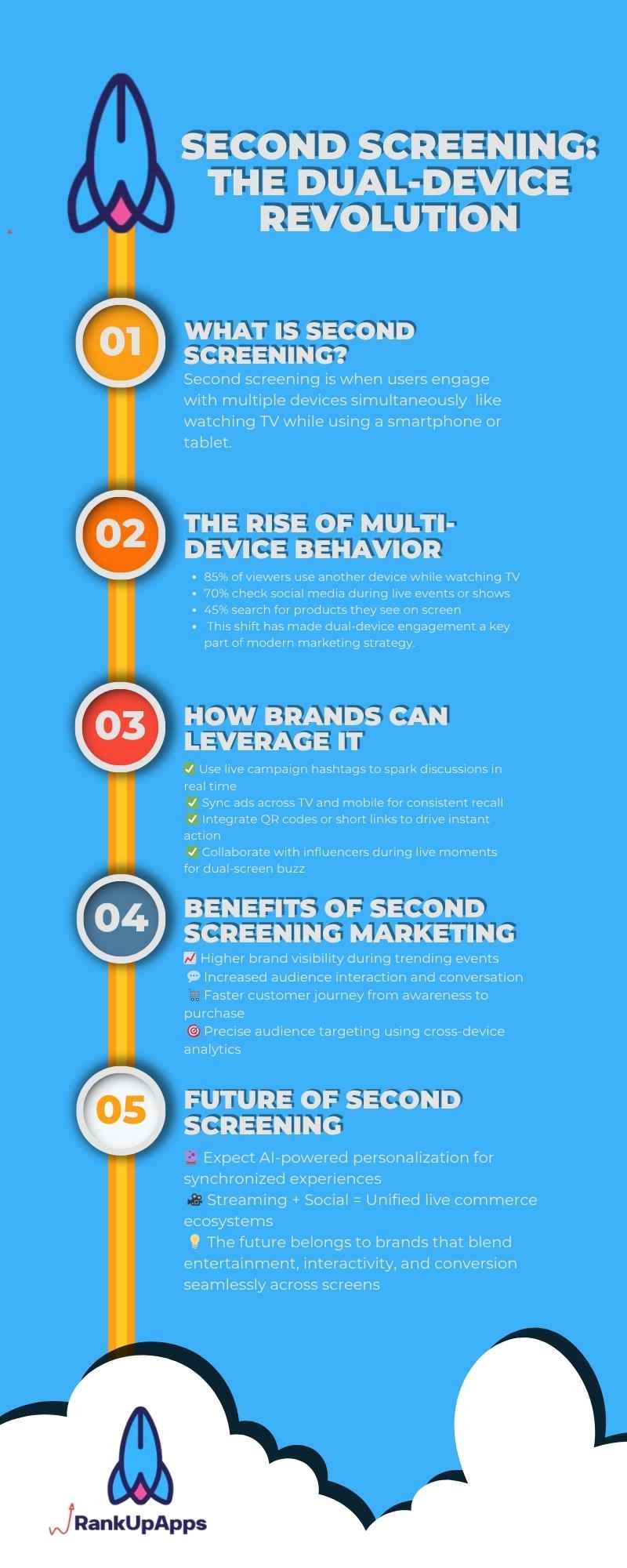
Second screening is the widespread consumer behavior of using a secondary device, typically a mobile phone or tablet, while simultaneously watching content on a primary screen like a TV or desktop. This dual-device behavior has fundamentally reshaped media consumption. For brands, understanding this behavior is vital: it fragments attention but creates new opportunities for second screen marketing and deeper multi-screen engagement, demanding adaptive digital strategies.
What Is Second Screening?
Second screen definition is the practice of consuming related or unrelated content on a separate device concurrently with a primary media source. This second screen behavior is now standard for over $80\%$ of viewers. It moves audiences from passive recipients of information to active, dual-channel participants.
Users engage a secondary device due to curiosity (looking up actors), social interaction (live-tweeting a show), or sheer need for multitasking. This creates a complex multi-screen audience that is always on and always connected.
How Second Screening Is Changing Media & Marketing?
The Shift from Passive Viewing to Multi-Device Interaction
Audiences are no longer confined to a single screen. When a critical moment occurs on TV, a viewer might instantly switch to their phone to search, share, or react. This means that engagement does not stop at the primary screen; it occurs across screens, demanding unified content strategies.
Marketing Opportunities & Challenges
Second screen marketing presents a dynamic opportunity to capture attention when traditional advertising on the primary screen may be ignored. However, the core challenge is divided attention and device switching. Brands must implement cross-screen advertising strategies that recognize and adapt to this media multitasking behavior to deliver synchronized, relevant messages.
Second Screening in Practice: Real-World Examples
Sports & Live Events
During major sporting events, the live event second screen experience is paramount. Users often watch the game on TV while simultaneously using their mobile device to track real-time fantasy league stats, check game scores, or place bets. This blend of primary viewing and instantaneous data access creates powerful second screen campaigns.
Entertainment & Streaming
While watching a movie or TV series, viewers frequently turn to their phones to check social media reactions, search for trivia on Wikipedia, or look up cast members.
Interactive Ad Campaigns
Savvy advertisers run second screen advertising by prompting a specific action during a TV commercial. This includes displaying a QR code or a unique hashtag that viewers can use to immediately access companion content, participate in a live poll, or enter a contest.
Benefits of Embracing Second Screening
Harnessing second screening offers significant advantages for modern marketers focused on digital growth:
- Increased Engagement: By providing related, interactive content (like polls, trivia, or supplementary articles) on the mobile device, brands can transform passive viewing into active multi-screen engagement. This significantly extends the time a consumer spends interacting with the brand’s narrative.
- Richer Data Collection: Tracking a user’s journey across devices from seeing an ad on TV to clicking a link on mobile provides invaluable cross-screen analytics. This offers a more complete picture of user behaviour, purchase pathways, and media influence than single-channel tracking.
- New Conversion Moments: The mobile screen is inherently transactional. A second screen strategy allows marketers to place calls-to-action right in the consumer’s hand, capturing impulse purchases or sign-ups the moment interest is piqued. The transition from passive viewing to transaction is nearly instant, providing unique conversion velocity.
- Enhanced Attribution: By syncing primary and secondary campaigns, marketers can accurately attribute the effectiveness of traditional media (like TV) to measurable digital actions, proving ROI for seemingly non-digital placements. These second screen benefits are essential for comprehensive marketing measurement.
Challenges and Considerations
While opportunities abound, the dual-device era introduces distinct hurdles that must be addressed:
- Divided Attention & Shorter Focus: The primary challenge is attention fragmentation. The audience’s focus is split between two screens, meaning messages must be extremely concise, visually striking, and immediately relevant to cut through the noise. The window of opportunity to capture attention on the secondary screen is often just a few seconds.
- Measurement & Attribution Complexity: Accurately solving measuring second screen effectiveness is notoriously difficult. TV and digital platforms use different tracking methods, making seamless cross-device attribution complex. Marketers must use advanced tools and fingerprinting technologies to match primary exposure to secondary actions.
- Content Relevance & Timing: A successful second screen strategy relies heavily on perfect timing. If a synchronized ad appears too early or too late, it loses all relevance. Content provided on the secondary screen must be directly complementary to the primary content, or risk being perceived as intrusive and irrelevant. The logistical complexity of deploying perfectly timed second screen challenges is substantial.
Best Strategies for Brands Using Second Screening
To capitalize on the dual-device marketing tips, brands must employ synchronized and interactive strategies:
Tip 1 – Sync Primary and Secondary Devices
Use $audio$ fingerprinting or real-time ad signal detection tools to launch mobile ad campaigns precisely when a TV commercial or key program moment is airing. This ensures maximum relevance and response rate.
Tip 2 – Create Interactive Content for the Second Screen
The secondary screen is for doing, not just watching. Develop dedicated, lightweight interactive experiences polls, quizzes, AR filters, live comment feeds that are easy to access and encourage audience interaction without diverting too much focus from the primary content.
Tip 3 – Monitor Cross-Device Analytics
Implement cross-screen analytics solutions that track user IDs and behaviours across both devices. Pay close attention to the lag time between the TV ad exposure and the mobile search/click to understand the conversion window.
Tip 4 – Use Real-Time Engagement Tools
Leverage social media platforms’ real-time capabilities. Run live Q&A sessions or use platform-specific features (like Instagram stickers or Twitter polls) that are directly referenced on the main screen to facilitate immediate, high-volume second screen engagement strategy.
The Future of Second Screening
The evolution of second screen technology promises even deeper integration and personalization:
- AI & Predictive Engagement Across Devices: AI is poised to become the ultimate solution for future of second screening. AI will analyze viewing habits, real-time sentiment, and in-the-moment search queries to predict the exact moment a user is about to switch devices, triggering hyper-personalized ads or content on the secondary screen before the user even completes the switch.
- AR/VR + Multi-Screen Experiences: As AR and VR become mainstream, the secondary device (the phone) will transition into a primary AR lens or controller. Imagine watching a travel show on TV while holding your phone up to experience AR models of the destinations or to purchase items directly from the virtual world.
- Evolving Metrics for Multi-Screen Campaigns: The current focus on CTR and impressions will shift toward “Shared Attention Score” or “Cross-Device Engagement Velocity.” New metrics will be required to accurately measure the synergy and impact across screens, driving the next iteration of multi-screen trends 2025 and marketing ROI.
Key Takeaways – What Marketers Must Remember
The key lesson is that second screening is not a distraction—it’s the new reality of engagement. For marketers, this represents a crucial opportunity to deepen connections:
- Design for the Device: Content on the secondary screen must be brief, actionable, and touch-optimized. It must serve a different purpose than the primary content.
- The Message Must Cross Devices: Ensure that your core brand message is consistent, regardless of which screen the consumer is looking at. Your dual-device marketing checklist must include unified brand voice and visual consistency.
- Prioritize Synchronization: Timing is everything. Use technology to deliver messages and interactive experiences the instant they are most relevant to the primary screen’s content.
- Measure Holistically: Accept that traditional attribution is dead. Adopt cross-device tracking to understand the full user journey and $ROI$.
These second screen takeaways emphasize synergy over separation.
Conclusion – Mastering the Second Screen Reality
Second screening conclusion is clear: the modern audience lives in a multi-screen world, fundamentally reshaping how media is consumed and how advertising is processed. Brands that continue to treat screens in isolation risk being ignored. By developing a sophisticated multi-screen engagement strategy that prioritizes real-time synchronization, interactive content, and robust cross-device analytics, you can turn a divided attention landscape into a powerful pathway for conversion and deep brand loyalty. The time to develop your cross-device strategies is now